




mikvah.org Homepage Login Mall Contact us Help Homepage
Mikvah Directory
Mikvah Mall
Mikvah Matters
Jewish Marriage
Jewish Childbirth
Jewish Family
Woman's Calendar
Speakers Bureau
Search essays


advanced
RITUAL BATH MAKES A COMEBACK

DAYTONA BEACH - It's a women's ritual as ancient as the Hebrew scriptures.

But in modern times, the concept of visiting a ritual bath -- or "mikveh" -- has become as foreign to most Jews as it is to the rest of the population.

So it was with more than a little curiosity that about 100 Jewish women from Volusia and Flagler counties gathered Tuesday night at Chabad Lubavitch of Greater Daytona to see the Ormond Beach synagogue's lavish new spa-like mikveh building, and hear a New York expert describe the benefits of marital relations -- biblical style.

Orthodox Jews believe that Sarah, wife of the biblical patriarch Abraham, was the first to regularly immerse herself in a mikveh -- a body of "living water" -- in compliance with the religion's laws of family purity.

And through the centuries, observant Jewish women have followed suit, going to ritual baths filled with rainwater as brides, and then monthly unless they were pregnant or too old to bear children.

But a mikveh (also spelled mikvah) is "not for the cleansing of the body," Sarah Karmely, an author and lecturer specializing in Jewish intimacy, explained at the opening event. Rather, a mikveh is "for purity of the soul."

And one of the biggest benefits of following the ritual is that it eliminates "the monotony from monogamy," she said.

For at least 12 days each month -- during menstruation and for seven days afterward -- an observant Jewish woman is supposed to be totally off-limits to her husband. Not even kissing or touching is allowed.

The couple has "no recourse but to talk to each other and develop respect for each other," said Karmely. Typically, during that time, both husband and wife start to long for what they can't have -- "like forbidden fruit," she said. Then, the woman goes to the mikveh, and they're able to rekindle the physical side of their marriage.

"God wants you to always be on a honeymoon," she said.

Eva Maman, who, along with her husband, Pinchas, funded and oversaw construction of the $320,000 Chabad mikveh as a gift to the Jewish community, likens the days of abstinence to longing for chocolate.

If you're on a diet, she said, and deny yourself chocolate for 12 days, when you finally have some "you enjoy every bite of it."

Maman, a 41-year-old a native of Israel, grew up as a secular, nonobservant Jew, but did go to a mikveh once before her wedding 20 years ago. Then, after moving to Ormond Beach, and joining Chabad several years ago, she was reintroduced to the concept by the rabbi's wife, Chani Ezagui.

"It changed my life," said Maman, whose four children range in age from 18 to 5-months old.

Ezagui, a 38-year-old mother of seven, estimates that there are about a dozen women in the community who regularly traveled to a mikveh in Orlando or Jacksonville before the local one was built.

But interest is growing, and there appears to be a resurgence of the mikveh concept worldwide.

"It's a spiritual cleansing . . . a spiritual pillar of Judaism," said Ezagui, that benefits the entire family.

"Many societies have ritual practices around menstruation," according Susan Starr Sered, an anthropologist at Suffolk University in Boston, who has written extensively on the subject. Humans have long been fascinated by the "enigmatic cyclical nature" of women, she said in a recent telephone interview.

But by the 1960s and '70s, the idea of a mikveh was interpreted by many Jewish women as sexist, she noted. And old-fashioned ritual baths were anything but appealing to modern sensibilities.

Over the past 15 years, however, a growing number of mainstream Jewish women, including feminists, have begun embracing the ritual as a liberating celebration of life transitions.

Women who have experienced a rape, surgery or other trauma sometimes also participate in the ritual to renew themselves, noted Sered. "There is a whole different way of thinking about women's bodies that is attractive to women right now," she said.

Chaya Sarah Zarchi of Mikvah.org, which offers a worldwide directory of Jewish ritual baths and information about the practice, confirms that the number has been growing steadily in recent years.

"There is a reawakened interest in this beautiful, beautiful mitzvah," she said in a telephone interview from Brooklyn, N.Y. (A mitzvah is a commandment or good deed.)

There are about 450-500 mikvehs in the United States in Canada, about 500 in Israel, and an estimated 200-300 in the rest of the world. The majority are new and attractive facilities such as Chabad's, according to Zarchi.

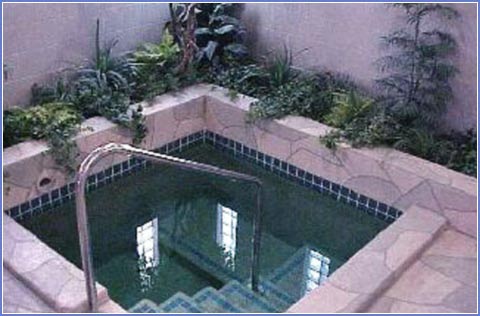
Rainwater at the Ormond Beach mikveh is collected in a specially constructed receptacle beneath the marble-encased immersion pool, and is kept lightly chlorinated and at a comfortable temperature. There are connecting shower and changing rooms. And a specially trained attendant assists with the ritual. Only one woman goes in at a time, completely naked, immersing herself under the water. Appointments are required and a $36 fee is charged.

There is also a separate mikveh in the building for orthodox men, some of whom traditionally immerse themselves before prayer and holidays.

"A man can go to elevate himself," said Karmely, the family purity expert. The mikveh is also used for conversions. But it's for women that the ritual has special relevance.

"This is for us, it's our mitzvah," she told the overflowing crowd of curious women -- answering everything they ever wanted to know and weren't afraid to ask.

The ritual bath also is a time for contemplation and prayer.

"All over the world women are looking for meaning in life," she said. And for an increasing number of Jewish women, the mikveh is helping them to find it.

Reprinted from news-journalonline.com 


User comments:
Post your comment

Be first to comment the article.